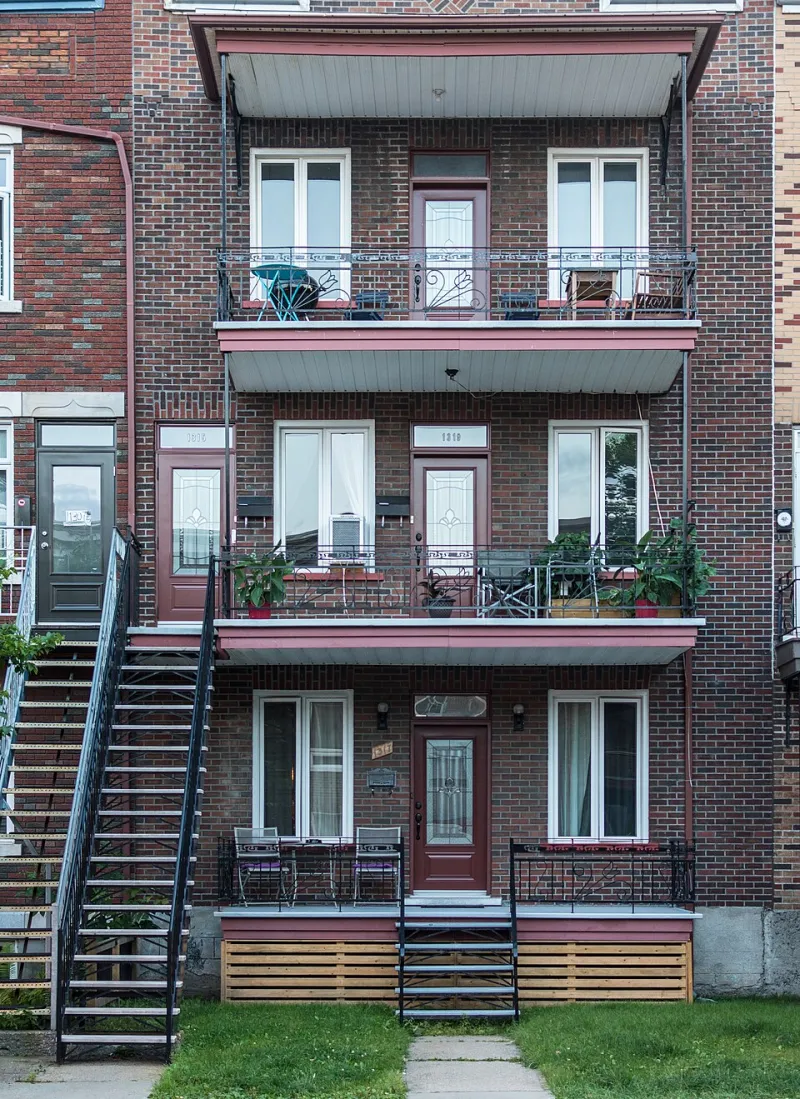
Three Doors, One Sweet Spot: Running the Numbers on Why the Triplex Wins
Photo: Rob Farrow, CC BY-SA 2.0, via Wikimedia Commons
Ask a room full of small multifamily investors why they chose their building size and you'll hear instincts, not arithmetic. Duplexes feel safe. Fourplexes feel efficient. The triplex, the awkward middle child, gets bought mostly by accident.
That's a mistake, and it's a mistake the spreadsheet can prove. Run honest pro formas across the three canonical small multifamily formats in a few representative US metros and a pattern emerges that is difficult to unsee: the three-unit building consistently occupies the sweet spot on nearly every metric that matters to an owner-occupant.
The Financing Cliff at Four Doors
Start with the constraint that shapes everything else. Under Fannie Mae and Freddie Mac rules, buildings of one to four units qualify for conventional residential financing; five and above pushes you into commercial lending. But within that band, the duplex and the triplex occupy meaningfully different territory than the fourplex when you're using an owner-occupied loan.
With 3 to 5 percent down on a HomeReady or Home Possible loan, a duplex buyer faces one rent check offsetting the mortgage. A triplex buyer gets two. A fourplex buyer gets three — but faces a stricter landscape: many lenders apply more conservative underwriting to four-unit properties, reserve requirements are higher, and appraisals on fourplexes draw from a thinner comparable pool, which can silently move your rate and your loan-to-value assumptions.
The fourplex also trips the first wire of commercial-style management. Four tenants means four leases, four potential turnovers in a single year, and a maintenance load that starts to feel like a job rather than a hedge.
Three Pro Formas, Three Metros
Consider representative owner-occupied acquisitions, using typical 2024-vintage pricing and rents:
Columbus, Ohio. A duplex near German Village: $340,000 purchase, one rented unit at $1,250, owner in the other. Effective housing cost after rent offset: roughly $1,400 monthly. A triplex two neighborhoods over: $430,000, two units renting at $1,250 each, offsetting roughly $2,500 — cutting the owner's effective cost to around $700. The fourplex at $540,000 with three rented units offsets $3,750 but adds $90,000 of acquisition capital and materially higher turnover risk.
Sacramento, California. Duplexes in the region commonly trade near $520,000 with one unit at $1,500. A triplex at $640,000 with two units at $1,500 offsets $3,000 monthly — often covering the majority of the total payment at today's rates. The fourplex, now well above the conforming loan comfort zone in many Sacramento zip codes, frequently requires jumbo or more restrictive products precisely at the moment the buyer's cash reserves are thinnest.
Pittsburgh, Pennsylvania. The classic Pittsburgh triple — a three-unit row building — remains one of the cleanest house-hack vehicles in America. At $310,000 with two units at $1,100, the owner's effective cost approaches zero. Duplexes in the same neighborhoods offer half that offset; fourplexes introduce commercial-adjacent management burdens the part-time landlord rarely prices honestly.
Across all three metros, the pattern holds: the triplex delivers roughly double the rent offset of the duplex for a 25 to 35 percent higher purchase price, while the fourplex demands a proportionally larger capital and management commitment for its incremental third rent check.
The Compliance and Management Threshold
Beyond financing, three units sit comfortably below several regulatory and operational tripwires. While ADA obligations attach to common areas in multifamily buildings regardless of unit count in most scenarios, the practical compliance burden — retrofit expectations, accessible-route questions, inspection frequency — escalates noticeably as buildings grow. Three units keeps the common-area footprint minimal: one entry, one stairwell, one roof.
Management follows the same curve. Two tenants is a roommate arrangement with paperwork. Four is a small property. Three is the largest portfolio a first-time landlord can run from a kitchen table without systems, software subscriptions, or a part-time maintenance roster — while still generating enough income that a single vacancy doesn't wreck the year.
The Vacancy Math Nobody Runs
Here is the argument that settles it. A duplex with one vacant unit has lost 50 percent of its income. A fourplex with one vacancy has lost 25 percent but carries 33 percent more fixed obligations — more HVAC, more roofs, more turnover costs. A triplex with one vacancy has lost a third of income while retaining two checks, typically enough to cover the mortgage outright. The three-unit building is the smallest structure in which a single vacancy is survivable rather than painful.
Buying the Middle Child on Purpose
None of this makes the triplex glamorous. It makes it rational: maximum income offset per unit of complexity, residential financing preserved, management burden contained, vacancy risk hedged. In Argentina — where the triplex is the default texture of middle-class housing rather than an investment strategy — nobody needed a spreadsheet to reach this conclusion. Three doors is simply how families have long balanced ownership costs against rental income. The American market is catching up to that arithmetic, one spreadsheet at a time. Run the numbers in your own metro, and expect the middle child to keep winning.