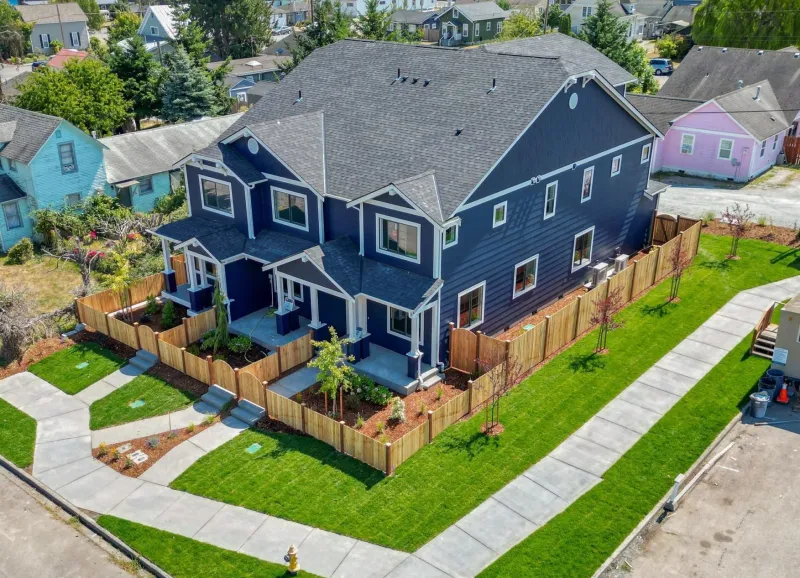
Your Tenant Pays the Mortgage: Inside the Owner-Occupied Triplex Strategy

Photo: Shixart1985, CC BY 2.0, via Wikimedia Commons
The pitch sounds almost too clean: buy a three-unit building, move into one apartment, rent the other two, and let your tenants retire your mortgage. Yet across US metros with functioning rental markets, the numbers routinely hold up. The strategy — house hacking — remains the most accessible entry point into real estate ownership for wage earners without large portfolios.
The Financing Mechanics
Because you occupy one unit, the property is treated as your primary residence. That unlocks:
- FHA loans: 3.5% down, flexible credit standards, and in high-cost counties, loan limits that comfortably accommodate triplex prices. Note the upfront and annual mortgage insurance premiums.
- Conventional owner-occupied loans: typically 15–25% down on a 3-unit property, but with no mortgage insurance and stronger long-term pricing.
- A residency requirement: most programs expect you to occupy the unit for at least 12 months. After that, you can move out and convert the building to a full rental — keeping the low-down-payment loan intact.
Three Markets, Three Scenarios
Cleveland, Ohio. A serviceable triplex in a stable near-west side neighborhood trades around $285,000. With FHA financing (3.5% down plus closing costs), the monthly payment with taxes, insurance, and MIP lands near $2,450. Two units renting at $1,150 each generate $2,300 — leaving a housing cost of roughly $150 per month.
San Antonio, Texas. A 1960s triplex on the city's south side lists near $395,000. A conventional 20% loan at prevailing rates produces a payment around $2,900. Market rents of $1,400–$1,500 per unit mean the two leased apartments cover approximately 95% of the carry.
Boston, Massachusetts. The classic triple-decker — a New England institution — runs $750,000+ in outer neighborhoods like Hyde Park. Even with FHA's higher loan limits here, the payment approaches $5,300. But two units at $2,600 each contribute $5,200, and the region's rent trajectory makes the long-term math compelling for buyers who can qualify.
The pattern is consistent: in low-cost metros, tenants nearly erase your housing cost; in high-cost metros, they offset a large share while appreciation does the heavy lifting.
The Tradeoffs, Stated Plainly
House hacking is not passive income with a nice kitchen. Consider honestly:
- You are the on-call landlord. A burst pipe at 11 p.m. is your burst pipe. Living on-site shortens the commute to zero.
- Privacy is structural, not guaranteed. Shared walls, shared entrances, and shared parking mean tenants become, in effect, neighbors you chose with a lease rather than a handshake.
- The 12-month occupancy clause is real. Plan your life around it before committing.
- Landlord-tenant boundaries blur. Set expectations in writing from day one — quiet hours, maintenance requests, common-area use — while the relationship is still professional.
Many investors find the tradeoff worthwhile precisely because it is temporary. After the residency period, the owner can relocate, rent the third unit at market rate, and own a fully leased triplex financed with primary-residence terms.
A Practical Starting Sequence
- Confirm your borrowing capacity with two or three lenders experienced in 2–4 unit FHA and conventional products.
- Target markets where a two-bedroom rent of at least 0.7% of the purchase price is achievable.
- Underwrite all three units — including the one you'll occupy — so the exit to full rental is already priced in.
- Budget a reserve fund of at least three months of expenses before closing.
One down payment, three income streams, and a housing cost that shrinks toward zero: for disciplined first-time buyers, the owner-occupied triplex remains the most underused wealth-building tool in American residential real estate.